be well-rounded…. CELEBRATE PI DAY
!
What’s pi? Pi is a number that comes from dividing the distance around a circle (i.e., circumference) by
the distance across that circle
(i.e., diameter). That ratio is the same number no matter how large the circle
is. Even though this relationship has been known for thousands of years, it was
only 3 centuries ago (1706) that the 16th lowercase Greek letter
π (pi, the first letter of the Greek word perimetrog for “surrounding
perimeter”) was introduced. Pi is an
irrational number and so its decimal representation never stops or repeats, but
computers have found the first 31 trillion (and counting) decimal places!
What’s “Pi Day”? We can write March 14 as 3-14, and 3.14 is the
beginning of that special number pi. For over 3 decades (thanks to
physicist Larry Shaw of San Francisco’s Exploratorium in 1988), math classes,
math clubs, and museums from coast to coast have observed each March 14 as PI
DAY, a chance to celebrate not just pi, but also the too-often-unsung beauty
and connections of all math in our world. By passing House Resolution 224 in
2009, the U.S.
House of Representatives enshrined March 14 as “Pi Day” to encourage
“schools and educators to observe the day with
appropriate activities that teach students about Pi and engage them about the
study of mathematics.” Pi Day
2015 was “Pi Day of the Century” because the
date 3/14/15 is the only one this century that contains not just three, but the
first five digits of pi! This “month/day/year” format is used mainly
in the US (and Belize), making Pi Day a fairly distinctive American holiday!
(And, yes, it’s also Einstein’s birthday.)
Pi day on RADIO: Louie Saenz did a 16-minute interview (incorporating 3 of my pi songs or song excerpts) of me for Pi Day 2019 on regional NPR-station KTEP (88.5 FM), https://www.ktep.org/post/focus-campus-larry-lesser-1; that same station has done several mid-March airings (since 2005) of my special “Pi Day” edition of the “Desert Diaries” show, which sparked the creation of a “math category” of episodes
Pi Day SONGS:
• I
wrote “American Pi” (click HERE to
hear a 3:53 demo recording and click HERE
for a related article with lyric and lesson) to present historical highlights
(and mnemonic for the first 6 significant figures) of the number pi, and may be
sung to the tune of Don McLean’s 1970s #1 hit “American Pie”. Varying versions
have appeared in several books and journals
and a rockin’ partial rendition by Calvin Coolidge (a band of then-high
schoolers in Cleveland) appears at http://www.youtube.com/watch?v=Ll_45NomcFk. On 3/14/15, the
National Museum of Mathematics announced my song won its “Pi Day of the
Century” song contest, which yielded media coverage (see
bottom of this webpage).
• I wrote “Circle Song”
(to the tune of “Twinkle, Twinkle, Little Star”) to help secondary school
students recall –and distinguish-- the two most common formulas associated with
circles. Click HERE
to hear my 0:38 demo recording, or HERE
to see a video, or HERE
to read an article with my lyric and accompanying commentary.
• my
favorite pi songs by others: facstaff.bloomu.edu/kferland/Pi_Songs/songs.html
(also, see https://youtu.be/XLK89OXaxz8 ; teachpi.org/music/rap.htm ; http://www.youtube.com/watch?v=kZSHr5E7fZY
; http://www.youtube.com/watch?v=Qs464DqnPTo&feature=related
; http://www.youtube.com/watch?v=tqdm8Rtj5PY&feature=player_profilepage
Pi Day Haiku (some say
“pi-ku”): I was announced by “Math Matters at Taylor &
Francis” social media on 4/8/15 as a winner of its 2015 Pi Day (of the Century)
haiku contest for my entry, which I later published in on p. 456 of http://scholarship.claremont.edu/jhm/vol8/iss1/22/).
Pi cartoon: https://www.causeweb.org/cause/resources/fun/cartoons/statisticians-favorite-uses-pi
Teacher ARTICLES:
See my 6-page article “Slices of Pi:
Rounding Up Ideas for Celebrating Pi Day” in the
fall 2004 Texas
Mathematics Teacher. Also of interest is Sandra A. Daire’s
Pi Day article “Celebrating Mathematics All Year ‘Round” in the March 2010 Mathematics Teacher, 103(7), 509-513. Also, teachers
interested in culturally relevant mathematics will appreciate my article in The Jewish Educator and
the “value of pi” section of my
article in Journal of Mathematics and
Culture.
classroom activity:
my “A Round This
Date in Time; Pizza Pi, Anyone?”
Cartoon Corner [with 9 classroom-ready discussion questions on 2 FoxTrot comic strips] in the March 2007 Mathematics Teaching in the Middle School,
12(7), pp. 383, 387. https://www.jstor.org/stable/41182436?seq=1#metadata_info_tab_contents
RESEARCHER ARTICLE I co-wrote about
family math nights which featured pi activities: “Parent Power
Nights: A Vehicle for Engaging Adults/Families in Learning Mathematics” in the Nov.
2008 Adults Learning Mathematics International Journal, 3(2b),
36-52.
Pi Day Local Outreach: I’ve helped with pi day events for elementary school students (e.g.,
Canutillo ES; see, for example, the article starting on p. 36 of this, middle school students (e.g.,
Henderson MS, as on p. 13 of this;
a grades 1-8 school (see this),
high school
students (e.g., Emery HS in Houston; see article in
fall 2004 Texas Mathematics Teacher), and
college
students (e.g., with UTEP’s undergraduate math club, Club Zero: see, for
example, the last page of this).
pi-pourri of other links:
http://www.piday.org/ http://www.pidayinternational.org/ http://piday.momath.org/ http://en.wikipedia.org/wiki/Pi_Day
www.piacrossamerica.org teachpi.org www.pidye.com http://www.nctm.org/resources/content.aspx?id=2147483830
illuminations.nctm.org/ActivityDetail.aspx?ID=161 www.exploratorium.edu/learning_studio/pi/
mathforum.org/t2t/faq/faq.pi.html www.mathmuseum.org/piday.htm www.mathwithmrherte.com/pi_day.htm
www.avoision.com/experiments/pi10k/pi10k.html en.wikipedia.org/wiki/Pi_Day http://megsl.org/pi.html
www.kathimitchell.com/pi.html mathworld.wolfram.com/Pi.html www.pi-world-ranking-list.com/lists/index.html
www-groups.dcs.st-and.ac.uk/~history/HistTopics/Pi_through_the_ages.html www.joyofpi.com/pilinks.html
eveander.com/trivia/ www.projectmathematics.com/storypi.htm www.mste.uiuc.edu/activity/estpi
polymer.bu.edu/java/java/montepi/montepiapplet.html www.math.utah.edu/~alfeld/Archimedes/Archimedes.html
http://www.youtube.com/watch?v=jG7vhMMXagQ
http://giveupinternet.com/2011/06/17/pi-constant-and-pie-mathematical-mind-blown-pic/
http://www.newscientist.com/blogs/nstv/2011/03/a-musical-interpretation-of-pi.html
MEDIA
COVERAGE OF MY PI DAY ACTIVITIES:
Interviewed on
3/14/19 by Louie Saenz, “Focus
on Campus”, aired 3/15/19 10-10:16am, regional NPR-station KTEP
(88.5 FM): https://www.ktep.org/post/focus-campus-larry-lesser-1
UTEP social
media posts on March 14, 2018 & 2017 such as:
https://www.facebook.com/UTEPMiners/videos/10152648258556160/
Herrera,
Valerie (2015, April 7). Professor wins pi day of the century contest. The Prospector, 100(23), 9.
Also: http://theprospectordaily.com/showcase/2015/04/07/professor-wins-pi-day-of-the-century-contest/
Cohen, Cindy
Graff (2015, April). Larry Lesser wins ‘Pi Day of the Century’ song contest. The Jewish Voice, p. 14.
Masterson,
Veronique (2015, March 20). [story on my winning
national pi day song contest was the closing
(and longest) story that week] UTEP Headlines Video Newscast, https://www.youtube.com/watch?v=EuaXz3sIcMc
UTEP News
(2015, March 16). Math song wins on pi day of the century. http://news.utep.edu/?p=29484
Facebook.com/UTEPMiners
(2015, March 14, 3:14pm). 2:38 video posted of me explaining Pi Day
Lopez, Meghan
(2015, March 14, 9:10pm). KFOX-TV
newscast, with online story by Adriana
Candelaria posted at http://www.kfoxtv.com/news/features/top-stories/stories/UTEP-professor-nominated-for-Pi-Day-of-the-Century-song-award-102922.shtml#.VQUYz2TF-gI
Rodriguez,
Ashlie (2015, March 14, at 5:14pm,
6:09pm,
10:09pm). ABC-affiliate KVIA-TV newscast
Wadsworth, Ford
(2015, March 22-28). Pi news [Whispers column]. El Paso Inc., 21(30), 7A.
Martinez, Aaron
(2015, March 15). UTEP professor wins songwriting
contest [18 column inches]. El Paso
Times, 135(74),
B1. [story also appeared online at http://elpasotimes.com/news/ci_27713752/utep-professor-wins-pi-day-century-songwriting-contest
the day before with same text but with different headline]
Lopez, Meghan
(2015, March 14, 10:15pm). CBS-affiliate KDBC-TV
newscast, with online story by
Adriana Candelaria posted at http://www.cbs4local.com/news/features/local-headlines/stories/MatheMusician-professor-engages-students-in-music-and-math-102935.shtml#.VQWS12TF-g
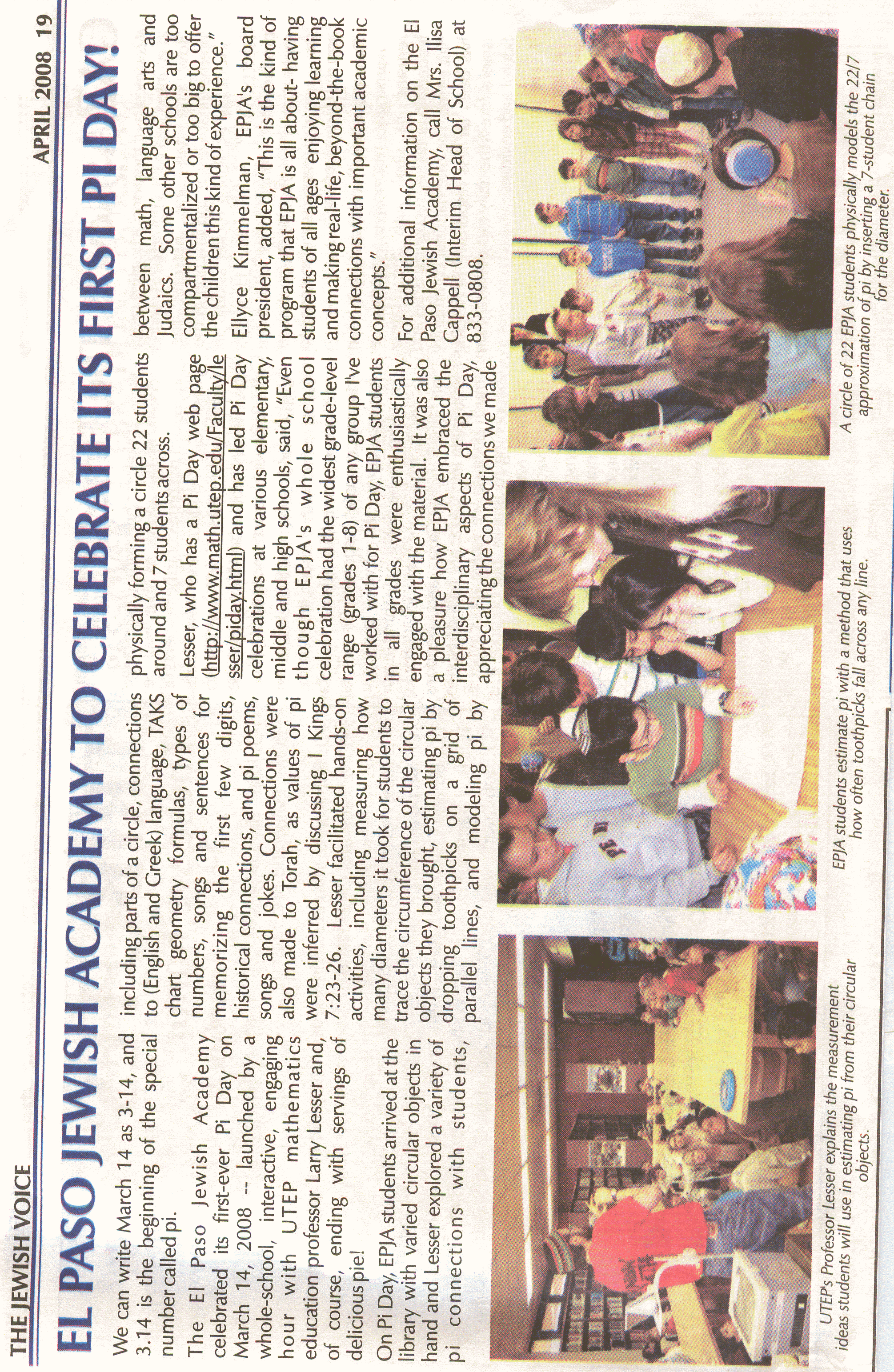
“El Paso Jewish Academy to Celebrate its First Pi Day!” (2008, April). The Jewish Voice, p. 19.
http://www.math.utep.edu/Faculty/lesser/EPJA2008piday.gif
“Pi x 300 years = fun for Canutillo
students” (2006, March 3). El Paso Times, 126(62), p. B6 West.
“Celebrating Pi” (2006, March 15). UTEP
Horizons Online News, Que Pasa.
https://www.ia.utep.edu/Default.aspx?tabid=37338
“Pi Day” segment (including interview with
me) from Canutillo ES on 10pm newscast on El Paso’s CBS-affiliate
KDBC-TV on
March 1, 2006; also, on El Paso’s KINT-TV (Univision, Channel 26).
“Henderson Middle” (2005, June), El Paso
PROPS Magazine, p. 15
“Pi Day Celebration” (2005, May), Newsletter
of Greater El Paso Council of Teachers of Mathematics, 4(5), 1-2.